You move money into savings, open your budgeting report, and discover that spending has apparently jumped. Nothing was bought. Nothing left your control. The report has confused a change of location with a change in what your household owns.
That distinction is the foundation of a useful financial record. A transfer answers where the money went. An expense answers what you consumed or paid for. Treating both as spending makes a sensible savings habit look like a budget problem.
Follow both sides of the movement
Imagine a current account holding 2,000 and a savings account holding 3,000, all in one currency. Salary adds 2,500 to the current account. Purchases reduce it by 1,200. You then move 800 into savings.
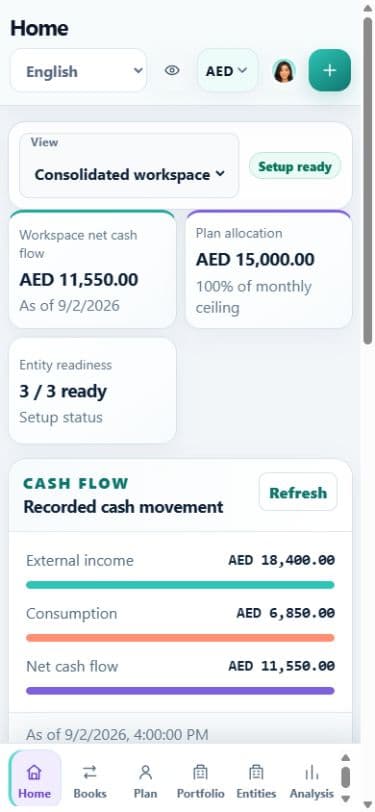
The current account should finish at 2,500 and savings at 3,800. Together they hold 6,300. Your combined cash increased by 1,300 because income exceeded consumption by that amount. The 800 transfer changed the distribution of cash, not the total.
A useful record preserves the source account, destination account, date, amount and currency. A bank statement may show only one side, so reviewing a single account can create the misleading impression that the transfer was a loss or a new source of income.
Decide what sits inside your financial boundary
The same payment can mean different things depending on whose finances the report covers. Moving money between two accounts you own is an internal transfer. Sending money as a gift to another independent household is not the same event, even when the recipient is a close relative.
Shared accounts need an explicit ownership decision. Do not assume that access to an account means you own its entire balance. Similarly, a business account should not silently become part of personal spending merely because you can operate it.
Write down the reporting boundary before categorizing complicated movements. That small decision prevents inconsistent treatment later.
Separate the transfer from its cost
Suppose a bank deducts 203 when you move 200 to another account, with a clearly stated fee of 3. The transfer is 200. The fee is 3. Recording the whole 203 as a transfer would hide a real cost, while recording the whole amount as spending would exaggerate consumption.
Cross-currency transfers require the actual amount leaving one account and the actual amount arriving in the other. Keep both original currencies. A reporting-currency conversion can help compare balances, but it does not replace the settlement evidence.
Check the report after recording it
For a same-currency transfer without fees, the combined cash balance should remain unchanged. Household income and consumption should also remain unchanged. Only the account balances should move.
When one side appears a day later, retain enough detail to match the pair rather than inventing an expense to make the first statement balance. When importing both accounts, check that the two statement entries have not become two separate economic events.
The CFPB's financial education toolkit includes spending, income and cash-flow tools. Those tools become more useful when account movements are kept distinct from the underlying money earned and spent. Consumer Financial Protection Bureau